
How AI Digital Workers Are Replacing Marketing Agencies in 2026
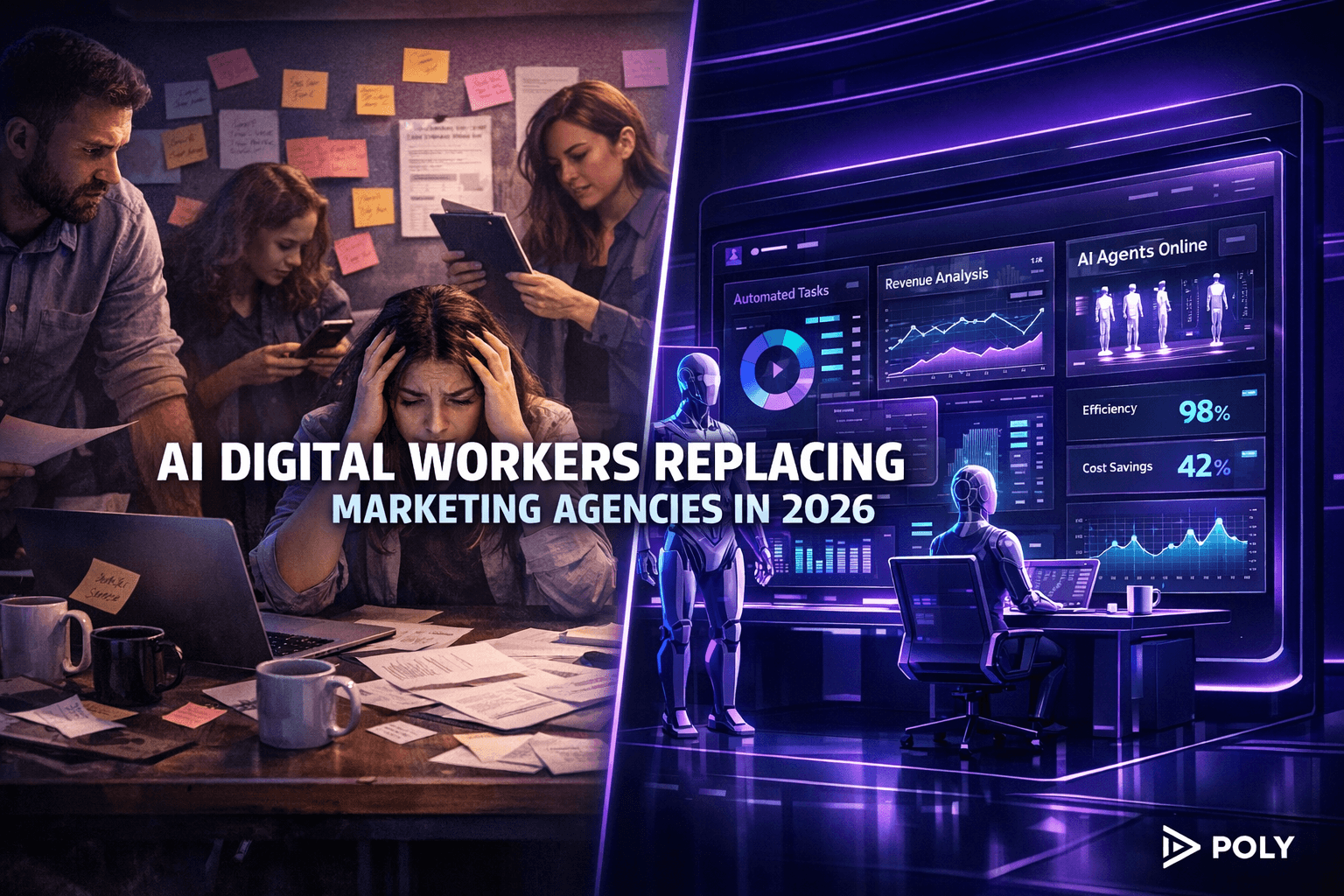
Table Of Content
- TL;DR
- Contents
- 1. The Agency Model Was Built for a Different Era
- 2. What an AI Digital Worker Actually Does
- 3. The Cost Comparison: Agency vs. AI Digital Workforce
- 4. Five Marketing Functions Already Being Displaced
- 5. Why 2026 Is the Inflection Point
- 6. What This Means for Your Marketing Team
- 7. The Honest Tradeoffs
- 8. How to Make the Transition Without Blowing Up Your Pipeline
- 9. Conclusion
- Sources
How AI Digital Workers Are Replacing Marketing Agencies in 2026
Generated on April 14, 2026 22:56 UTC
Published: April 2026 | Reading time: ~9 min | Author: Poly186
TL;DR
- Traditional marketing agency retainers run $3,000–$15,000/month for SMBs — AI digital workers deliver comparable output for a fraction of that cost.
- 73% of SMBs that adopted AI agents in 2025 reported measurable productivity gains within 90 days (Digital Applied, Feb 2026).
- AI marketing automation delivers up to 544% ROI over three years and cuts operational costs by 25–30% (RevenueMemo, Feb 2026).
- The shift isn't about replacing humans with robots — it's about replacing agency overhead with always-on, outcome-focused digital workers that integrate directly into your stack.
- SMB founders and marketing managers who move first gain a compounding competitive advantage; those who wait are funding their competitors' growth.
Contents
- The Agency Model Was Built for a Different Era
- What an AI Digital Worker Actually Does
- The Cost Comparison: Agency vs. AI Digital Workforce
- Five Marketing Functions Already Being Displaced
- Why 2026 Is the Inflection Point
- What This Means for Your Marketing Team
- The Honest Tradeoffs
- How to Make the Transition Without Blowing Up Your Pipeline
- Conclusion
- Sources
1. The Agency Model Was Built for a Different Era
There's a reason the traditional marketing agency retainer exists: coordinating strategy, creative, copy, ads management, and reporting used to require a team of specialists. You couldn't run that operation in-house at a reasonable cost, so you outsourced it.
That logic held for about 30 years.
In 2026, it's starting to crack.
Not because agencies are bad at what they do — many are excellent. The crack is structural. The agency model prices in human hours: account management overhead, internal coordination, layer-on-layer approvals, and the economics of running a services business. An SMB paying $5,000/month to an agency is paying for maybe 15–20 hours of actual execution time, spread across three or four people who also have 10 other clients.
The output ceiling is set by human bandwidth. And human bandwidth is expensive.
AI digital workers don't have that ceiling. They run 24/7, don't take onboarding weeks, don't bill for internal meetings, and don't have competing account priorities. They also don't get sick, don't lose institutional knowledge when a team member quits, and don't charge extra for a content sprint before a product launch.
This isn't a philosophical argument about AI. It's a math argument. And the math is changing fast.
2. What an AI Digital Worker Actually Does
The term "AI agent" has been diluted. Every SaaS product with a chatbot is calling itself an AI agent now. So let's be specific about what a genuine AI digital worker actually looks like in a marketing context.
A real AI digital worker:
- Executes multi-step workflows autonomously — not just generating a draft, but researching, writing, formatting, publishing, and reporting, in sequence, without a human touching every step.
- Holds persistent memory — it knows your brand voice, your ICP, your past campaign performance, what performed and what didn't, and uses that context in every execution.
- Integrates with your actual stack — CRM, ad platforms, email tools, CMS, analytics. It doesn't sit beside your workflow; it runs inside it.
- Adapts to feedback loops — when a campaign underperforms, it registers why and adjusts. Not next quarter — next cycle.
- Operates across specializations — content strategy, SEO research, ad copy, email sequences, social media scheduling, competitor monitoring. You get a full marketing department, not a single-task tool.
Platforms like Poly186 deploy these workers inside a structured "digital workforce" — dozens of specialists (content researcher, creative director, channel manager, campaign analyst, etc.) operating as a coordinated team, not isolated point tools.
Compare that to what a traditional agency account team typically looks like for an SMB: one account manager, one strategist, one or two execution specialists, and a creative team you share with their other clients. The AI digital workforce model inverts the economics entirely.
3. The Cost Comparison: Agency vs. AI Digital Workforce
Let's run the actual numbers. These are real market rates, not hypotheticals.
| Engagement Model | Monthly Cost (SMB) | Execution Hours | Scalability |
|---|---|---|---|
| Boutique marketing agency | $3,000 – $8,000 | 15–30 hrs/month | Capped by headcount |
| Full-service agency | $8,000 – $20,000 | 40–80 hrs/month | Expensive to scale |
| Freelancer mix (DIY) | $2,000 – $5,000 | Variable, uncoordinated | Coordination overhead kills efficiency |
| In-house marketing hire | $7,000 – $12,000/mo fully loaded | 160 hrs/month | One person, one skill set |
| AI digital workforce | $500 – $3,000/month | Effectively unlimited | Scales to demand instantly |
The cost differential is significant. But the more important metric is output per dollar.
A March 2026 analysis by Battlebridge found that SMBs using AI-first marketing models were producing 3–5x more content output and running 2x more campaigns simultaneously compared to agency-managed accounts at similar spend levels.
The AI marketing automation category as a whole is delivering a 544% ROI over three years and cutting operational costs by 25–30%, according to RevenueMemo's 2026 benchmarking analysis. A separate case study from Supa Labs showed a 353% ROI from AI-augmented marketing workflows, including a 30% reduction in customer acquisition cost and 20% lift in conversion rates.
Those numbers aren't coming from enterprise companies with dedicated AI teams. They're coming from SMBs making the switch.
4. Five Marketing Functions Already Being Displaced
This isn't speculative. These are the five areas where AI digital workers are already delivering at or above agency-level output:
4.1 Content Production
Blog posts, social content, email sequences, ad copy, video scripts — the full content stack. AI workers with persistent brand voice memory and ICP awareness produce consistent, on-brand content at a volume that no agency account can match at typical SMB price points.
A Forbes-covered study from July 2025 found that AI saves SMB marketers an average of 13 hours per week — roughly one-third of a full working week — specifically on content-related tasks. That's the equivalent of getting a part-time marketing hire for free.
4.2 Campaign Research and Trend Intelligence
Competitor monitoring, hashtag research, audience behavior analysis, trend identification — historically this was expensive agency time or a dedicated research subscription. AI workers now run continuous intelligence cycles: scanning competitor ad libraries, monitoring platform trends, and surfacing actionable briefs before the content calendar is even built.
4.3 Paid Media Management
Ad copywriting, A/B test design, audience segmentation analysis, and performance reporting are increasingly automated. The repetitive, rules-based work of managing ad variations at scale is exactly where AI workers outperform human teams on cost-per-iteration.
4.4 SEO and Organic Growth Operations
Keyword research, content briefing, on-page optimization, internal linking strategy, and performance tracking are converging into a continuous AI workflow. What used to require a dedicated SEO agency or retainer can now run as an ongoing background operation.
4.5 CRM and Lead Nurture Sequences
Building and maintaining lead nurture flows — trigger-based emails, segmentation logic, follow-up sequences — is pure workflow automation. An AI digital worker connected to HubSpot or Salesforce doesn't need to be briefed on your funnel every quarter. It already knows it.
5. Why 2026 Is the Inflection Point
The underlying capabilities have been building for two to three years. What changed in 2025–2026 is affordability and reliability at the SMB tier.
According to a February 2026 analysis by Reinventing.ai, SMB AI agent adoption has hit an inflection point as costs dropped and reliability increased. The key statistic: 73% of SMBs that adopted AI agents in 2025 reported measurable productivity gains within 90 days.
That 90-day payback window changes the risk calculus entirely. For most SMBs, a new agency relationship takes 90 days to ramp up and another 90 to show results. AI digital workers are now matching that timeline on the front end — and maintaining output without the ramp-up costs of a new agency onboarding.
Three additional forces are accelerating this shift:
Enterprise validation. ServiceNow, Salesforce, and UiPath are all moving toward autonomous AI workforce models. When enterprise vendors converge on "autonomous execution" as the standard, SMB buyers follow within 12–18 months. That timeline puts mass SMB adoption squarely in 2026.
Category language is settling. The buyer conversation has shifted from "should I use AI?" to "which AI workforce model is right for us?" That's a fundamentally different buyer mindset. The trust gap that existed in 2024 is narrowing because there's now 18 months of real-world SMB performance data.
The talent market is not getting cheaper. A fully loaded marketing hire still runs $7,000–$12,000/month for a single person. Agencies haven't reduced their rates. The cost pressure on SMBs is structural, and AI is the only lever that meaningfully changes the math.
6. What This Means for Your Marketing Team
If you're a founder or marketing manager at a 50–500 person company, this is the practical read:
You don't need to fire your agency tomorrow. Most SMBs will run a hybrid model through 2026 — AI workers handling the operational execution layer (content, research, reporting, nurture flows) while human strategists or agency partners handle high-stakes creative decisions and relationship-driven work.
You do need to stop treating AI as a tool and start treating it as a workforce layer. A single AI writing tool is a feature. A coordinated team of AI workers — researcher, strategist, creative director, channel managers, analyst — operating against your KPIs is a competitive infrastructure.
The compounding advantage is real. Every cycle of AI execution generates performance data that informs the next cycle. An AI workforce that's been running your content and campaigns for six months knows your audience, your best-performing angles, and your competitive landscape better than a new agency hire ever will at the six-month mark.
Pipeline per headcount is the metric that matters. Not "how much AI can we afford" but "how much pipeline are we generating per marketing dollar." Companies running AI digital workforces are already reporting 2–3x pipeline per headcount versus traditionally staffed marketing operations.
7. The Honest Tradeoffs
This article is data-backed, not a sales pitch, so the tradeoffs deserve a real look.
What AI workers are still not great at:
- Long-form strategic consulting that requires deep industry relationship context
- Brand repositioning decisions that require senior human judgment and stakeholder buy-in
- High-touch creative campaigns requiring unique human cultural intuition and originality at the concept stage
- PR and earned media relationships where the human element is genuinely irreplaceable
What SMBs consistently underestimate:
- Integration setup time. Connecting AI workers to your actual stack — CRM, ad accounts, CMS, analytics — takes real work upfront. Budget 4–8 weeks for a proper implementation.
- Quality oversight. AI workers produce volume. You still need a human reviewing output before it goes to a client or gets published to a high-stakes channel.
- The learning curve isn't zero. Training AI workers on your brand voice, ICP nuances, and campaign history takes intentional onboarding. It's not plug-and-play on day one.
These tradeoffs don't undermine the economics. They just mean the transition requires a real plan, not a tool purchase.
8. How to Make the Transition Without Blowing Up Your Pipeline
If you're ready to move, here's a practical 90-day framework:
Days 1–30: Audit and identify displacement candidates Map your current marketing spend. List every function you're paying for — agency, freelance, in-house — and score each on: repeatability, volume, and sensitivity (how bad is it if something goes wrong?). High repeatability, high volume, low sensitivity functions are your first AI displacement targets. Content production, research, and reporting almost always land here.
Days 31–60: Parallel run Run AI workers alongside your existing setup for the highest-value displacement candidate (usually content or ad copy). Measure output volume, turnaround time, and quality. Don't cancel your agency contract yet — use this phase to build confidence in the output and identify gaps.
Days 61–90: Transition and measure Move the first function fully to AI execution. Document cost savings and output changes. Use the savings to fund the next phase. Most SMBs find the ROI visible within this window.
The goal: By month six, your AI workforce is running your operational marketing layer — content, research, nurture, reporting — and your human team or remaining agency resources are focused on strategy, high-stakes creative, and relationships.
9. Conclusion
The marketing agency model isn't dying because agencies are bad. It's being disrupted because the economic logic that justified it — you need human teams to coordinate and execute marketing at scale — is no longer true for most SMB use cases.
AI digital workers are already handling content production, campaign research, paid media management, SEO operations, and CRM nurture flows at lower cost and higher volume than traditional agency retainers. The 2025–2026 adoption data confirms this isn't a trend — it's a market shift that's already underway.
For SMB founders and marketing managers, the question is no longer "will AI change marketing?" That's settled. The question is: how fast are you moving, and how much runway are you giving your competitors?
If you want to see what a fully deployed AI digital workforce looks like inside a real SMB marketing operation — schedule a call and we'll show you the actual setup, the actual numbers, and what it would take to implement in your stack.
Book a 30-minute walkthrough → cal.com/princepspolycap/poly-digital-workforce
Sources
-
Digital Applied / Reinventing.ai — "Small Business AI Agent Adoption Reaches Inflection Point as Costs Drop" (February 19, 2026). insights.reinventing.ai
-
Forbes / Ron Schmelzer — "New Study: AI Cuts Costs, Adds 13 Hours For SMB Marketers" (July 20, 2025). forbes.com
-
RevenueMemo — "Marketing Automation ROI Statistics for 2026: A Comprehensive Analysis" (February 16, 2026). revenuememo.com
-
Battlebridge — "The True Cost of a Marketing Agency in 2026: Agency vs. AI vs. In-House" (March 11, 2026). battlebridge.com
-
Supa Labs — "AI Marketing Automation Case Study: 353% ROI, 30% CAC Reduction" (December 3, 2025). supalabs.co
-
ServiceNow — "ServiceNow Launches Autonomous Workforce" (February 2026). businesswire.com
-
Qurrent / PR Newswire — "$15M Raise for Digital Workforce Infrastructure" (2026). prnewswire.com
-
Spark Novus — "Marketing AI Pulse Brief: Agents, Shrinking Moats, and the Rise of Trust" (March 2026). sparknovus.com
-
Dallas Fed — "AI Is Simultaneously Aiding and Replacing Workers, Wage Data Suggest" (February 24, 2026). dallasfed.org
Poly186 builds AI digital workforces for B2B SaaS companies and SMBs. Our workers handle content, research, campaigns, and pipeline operations — fully integrated with your existing stack.
Schedule a walkthrough → cal.com/princepspolycap/poly-digital-workforce