
Why Agency Margins Die When You Cross 50 Employees

Published: March 2026 | Reading time: ~8 minutes
TL;DR
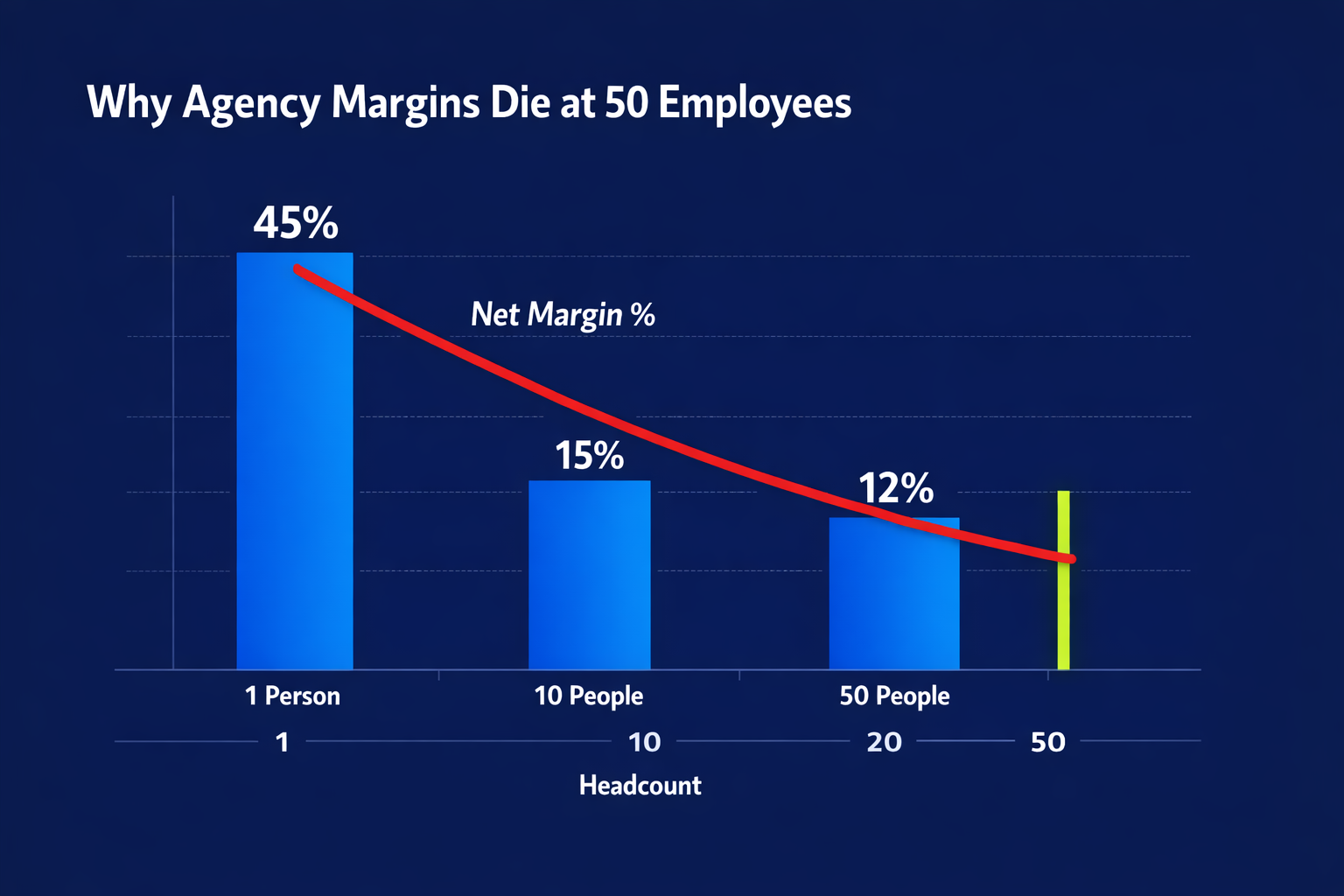
- A solo agency founder can clear 40-50% net margins. A well-run 50-person agency targets 10-15% — and many land in single digits.
- The five structural killers: mandatory management layer, utilization rate decline, systemic scope creep, junior talent dilution, and regulatory cost jumps.
- A 5-percentage-point drop in utilization across a 50-person team translates to roughly $264,000 in lost annual profit — without a single new expense.
- Revenue per employee is the canary in the coal mine. Mid-size agencies should target $150K-$200K per head; when new hires drag that down, systems aren't keeping pace with headcount.
- The alternative path — staying at 15-20 people deliberately — generates better economics than most 50-person agencies achieve.
Contents
- The Numbers First
- What Actually Happens at 50
- The Growth Trap Psychology
- What the Agencies That Survive It Do Differently
- The Alternative Path: Intentional Constraints
- The Bottom Line
- Sources
The agency growth story usually sounds something like this: you build a tight team, land a few great clients, revenue climbs, you hire more people, and revenue climbs further. At some point somebody puts a number on the whiteboard. "We're going to hit 50 people by end of year." Champagne emoji in Slack. The team celebrates.
Then the P&L quietly starts bleeding.
This isn't a management failure story, or a hiring-the-wrong-people story. It's a structural one. Agencies are fundamentally different from software companies or product businesses. You sell human hours, and when you add humans, you don't automatically add proportional profit. At a certain headcount, the opposite starts happening. The 50-person threshold is where most agencies find out this lesson the hard way.
The Numbers First
Before the theory, the data.
A solo founder running a lean agency can target 40-50% net profit margins. A small 5-10 person shop will see those compress to 10-20% as salary costs accumulate. But look at what happens at 50 people: industry benchmarks suggest a well-run 50-person agency is targeting 10-15% net profit after all costs — and that's if they're executing well. Many land in single digits. (Sidekick Accounting, March 2026)
Gross margins tell a similar story. Solo operators run 60-70% gross margins. Scale to a 50-person team and that number compresses to 50-60% — before overhead, before the management hires, before the new office you signed a lease on because twenty people working from WeWork was getting embarrassing.
The 2026 Agency Profitability Report from Planable, which surveyed data from 186 SEO, social media, and multi-service agencies, put it plainly: "Growth without margin is just a more complicated version of the same problem." That report was published in March 2026 and it still reads like a gut punch to anyone who's been chasing headcount as a proxy for success.
For revenue per employee — a clean efficiency metric — mid-sized agencies benchmark between $150,000 and $200,000 per head. Elite agencies push past $300,000. But as headcount grows past 50, that number typically starts falling rather than rising, because you're adding coordination infrastructure that doesn't directly bill hours. (TimeTackle, February 2026)
What Actually Happens at 50
1. You Have to Build a Middle Layer
At 10 people, the founder talks to everyone. At 20, there are senior people who absorb some of that. At 35-40, you're still mostly managing by proximity. At 50, something breaks. You physically cannot oversee delivery across 10-15 concurrent client engagements anymore. So you hire account directors. You promote a VP of Operations. You bring in an HR manager because onboarding is now a full-time job. You hire a finance person because your bookkeeper can't keep up.
None of these people bill a single hour to clients.
They are, in accounting terms, pure overhead. And they're expensive overhead — these are typically your highest-cost hires. An account director or VP at a mid-market agency runs $120,000-$180,000 in salary alone. Add benefits, payroll taxes, equipment, and management time, and you're looking at a fully-loaded cost well over $200,000 for a single non-billable headcount. (IOTA Finance, February 2026)
The 55/25/20 framework — widely used in agency financial planning — suggests allocating 55% of revenue to delivery costs, 25% to overhead, and targeting 20% net profit. The problem is that the management layer you're building lands squarely in that 25% bucket. At 50+ employees, that bucket starts overflowing. (Swydo, February 2026)
2. Utilization Rates Fall Off a Cliff
Utilization — the percentage of available time your team spends on billable work — is the single most important profitability lever in an agency. When it goes up, profit follows. When it goes down, profit evaporates faster than you'd believe.
Advertising agencies average around 60% billable utilization across the team. Under 50% is considered a red flag. (CreativePool, May 2025) Here's the problem: the 60% average includes small agencies where everyone is heads-down on client work. As you scale past 50, the math shifts.
Every internal meeting, every all-hands, every onboarding session for a new hire, every "quick sync" between team leads is unbillable. In a 10-person agency, this overhead is minimal because there aren't many layers for information to pass through. In a 50-person agency, you've created an organism with a nervous system that requires constant maintenance just to function.
The economic impact is savage. A 5-percentage-point drop in utilization across a 50-person team — say from 65% to 60% — translates to roughly $264,000 in lost annual profit at typical billing rates, without touching a single line item on your P&L. (Rework capacity planning model) That's not a cost increase. That's capacity that exists on paper but never converts to revenue.
3. Scope Creep Becomes Systemic
At 10 people, scope creep is a client management problem. At 50, it becomes a structural leak in the hull.
When delivery teams grow, communication between the people scoping work and the people executing it degrades. Account managers promise deliverables that delivery teams can't complete within budget. Project managers inherit scope that was never properly defined. Revisions multiply. Internal quality review cycles that didn't exist at 15 people become mandatory at 50 — and somebody has to staff them.
According to Worklenz's analysis of agency scaling from 5 to 50 people (March 2026), the breakdown in project control is the primary driver of margin erosion in this growth phase — not pricing, not client mix, not even salary inflation. The work simply takes longer than it should because no one has a clean picture of what was sold, what was built, and where the gap is. (Worklenz, March 2026)
4. The Talent Paradox
Here's a counterintuitive dynamic: when you're a 10-person agency, you often have 10 senior people. Everyone is good at their job. That's why you made it to 10. But scaling to 50 means hiring people who aren't as good, because there aren't 50 "senior-level" people available in your market at the price you can pay.
So you hire junior talent and plan to train them. Training costs money. Junior staff need review cycles that senior staff don't. Their work requires more iteration. Their client interactions require more supervision. The effective cost per billable hour is higher than it looks on the salary line, because the senior staff you're paying for end up spending meaningful time on review and mentorship rather than client delivery.
This is why agencies that hit 50 people often feel busier than ever while their per-client profitability shrinks. More people, more activity, more meetings — less margin.
5. The ACA/Benefits Cliff
In the US, the Affordable Care Act mandates employer-provided health insurance once you cross 50 full-time employees. This is a literal regulatory threshold that creates a cost jump. But even outside the US, most agencies find that 50 employees triggers new obligations: mandatory HR policies, formalized performance review processes, potentially union considerations in some markets, and benefits parity expectations as employees start comparing notes with each other.
These aren't discretionary costs. They're the tax of size.
The Growth Trap Psychology
Part of what makes this painful is that crossing 50 people feels like success. Revenue is almost certainly higher than it was at 15. The team is doing impressive work. Clients are happy. The founder is getting invited to speak on podcasts about building agencies. Nobody is panicking.
But the P&L is quietly flashing yellow. The founder is working more hours than they did at 10 people. The "management team" is expensive and still not running things smoothly. Client work is still requiring founder involvement because process hasn't caught up with headcount.
The Seven Figure Agency community has a name for this: the "growth trap" — where rapid hiring triggers hidden costs, quality erosion, and profit compression simultaneously, precisely when the firm looks most successful from the outside. (Marketing Career Insights, February 2026)
The trap works because agency founders are trained to read revenue as the primary health indicator. When revenue is climbing, everything looks fine. Margin is a lagging signal. By the time it shows up in the numbers, you've already locked in the headcount, signed the office lease, and committed to salary structures you can't easily reverse.
What the Agencies That Survive It Do Differently
The data does show agencies that make it through this phase. They share a few common traits.
They treat utilization as a top-line metric, not a lagging report. Agencies that maintain margins through growth track utilization weekly, at the team and individual level. When it drops, they find out why before the next billing cycle. They don't wait for a quarterly P&L review to discover a problem that started six months ago.
They price the overhead into contracts before they hire. Firms that survive the 50-person phase revised their pricing models before adding the management layer — not after. They built the cost of an operations director or VP into their rate card 12 months before making the hire.
They stay ruthlessly disciplined on scope at proposal stage. The agencies with healthy margins at 50+ people have invested heavily in scoping discipline: fixed deliverable lists, documented change order processes, and account managers who are accountable to delivery margins rather than just client satisfaction scores.
They use revenue per employee as a leading indicator. The target: $150,000-$200,000 minimum, with elite shops targeting $250,000+. When new hires push that number down, it's a signal that productivity systems aren't keeping pace with headcount growth. (Dynamic Agency OS, August 2025)
The Alternative Path: Intentional Constraints
Some agency founders look at this data and make a different choice: stay small deliberately.
A 15-20 person agency with tight process, good pricing, and low overhead can sustain 25-35% net margins. That's a business generating $3-5M in revenue with the owner taking home more than many agencies twice its size. You skip the management layer. You skip the coordination overhead. Every person on the team touches client work. Utilization stays high.
This isn't failure. It's a strategic choice that market pressure to "scale" makes harder to defend publicly — but the economics support it clearly.
The 2026 Planable Agency Profitability benchmarks back this up: the size band with the most consistent profitability isn't 50 people. It's 10-20, where teams are large enough to take meaningful client engagements but small enough to avoid the infrastructure drag.
Some of the most profitable service businesses running today aren't the ones chasing headcount records. They're the ones that figured out how to automate coordination, standardize delivery, and keep every hour on the team tied to client outcomes — not internal maintenance. Whether that means staying lean intentionally or rethinking how work gets done as you scale, the principle is the same: margin comes from efficiency, not size.
The Bottom Line
Crossing 50 employees doesn't kill agency margins because something mysteriously breaks. It kills margins because of a very predictable set of structural forces: mandatory overhead hires, falling utilization, scope control breakdowns, junior talent dilution, and regulatory cost jumps.
The founders who navigate it successfully do so by treating margin as the primary metric — not revenue, not headcount, not office size — and building systems ahead of growth rather than scrambling to retrofit them after the fact.
The ones who don't navigate it successfully typically find out the hard way, usually about 18-24 months after the champagne emoji Slack message, when the P&L finally tells the story the revenue numbers were hiding all along.
If you're an agency founder wondering how to scale delivery without adding headcount proportionally, Poly's AI-native digital workforce is built exactly for that problem — persistent digital workers that handle coordination, reporting, and execution overhead without hitting your utilization rate. Or book a 30-minute call to see how it works in practice.
Sources
- Sidekick Accounting, "Agency Profit Benchmarks by Size" (March 2026): sidekickaccounting.co.uk
- Planable, "Agency Profitability Report: Benchmarks & Trends 2026" (March 2026): planable.io
- Swydo, "Agency Profitability Guide — Benchmarks, Metrics, and Margins" (February 2026): swydo.com
- IOTA Finance, "Agency Profit Margins: 2026 Benchmarks" (February 2026): iota-finance.com
- TimeTackle, "Revenue Per Employee Benchmark Guide for Agencies" (February 2026): timetackle.com
- Dynamic Agency OS, "Revenue per FTE Benchmark" (August 2025): dynamicagencyos.com
- CreativePool, "Billable vs. Non-Billable Hours: Where Your Agency Is Bleeding Money" (May 2025): creativepool.com
- Worklenz, "Scaling Your Agency From 5 To 50 People Without Losing Project Control" (March 2026): worklenz.com
- Rework, "Utilization & Capacity Planning" (professional services growth model): resources.rework.com
- Marketing Career Insights, "Agency Growth is a Trap: Why Scaling to 50 People Might Be Your Worst Business Move" (February 2026): marketingcareerinsights.com
- tMetric, "Marketing Agency Benchmarks 2026: Profitability, Utilization & Revenue" (November 2025): blog.tmetric.com